
Enrollment across the State University of New York (SUNY) system is growing for the fourth consecutive year, reversing a long-running trend of declining student populations. But not every Western New York campus is sharing in that success.
SUNY Chancellor Dr. John King says the system now has 392,401 students, an increase of 1.3% from last year and up nearly 8% since 2022.
In an interview with 7 News, Dr. King credited the turnaround to the affordability of SUNY schools, increased state funding and new programs designed to attract adult learners.
"I think New Yorkers are seeing the affordable excellence that is available at SUNY," Dr. King said. "Our four-year institutions, the tuition for a full year is $7,070. That's incredibly affordable compared to private colleges, compared to other public systems."
Dr. King said the growth is particularly significant because it follows years of declining enrollment.
"Not only is it four years in a row of growth across every sector, but this is really the first time we've had that in at least 25 years," he said.
Mixed results in Western New YorkWhile enrollment is increasing statewide, the picture is more complicated at colleges and universities in Western New York.
Enrollment at the University at Buffalo remained relatively flat this year, despite challenges involving international students.
SUNY Erie and most other community colleges are also seeing encouraging results, particularly through the state's SUNY Reconnect program.
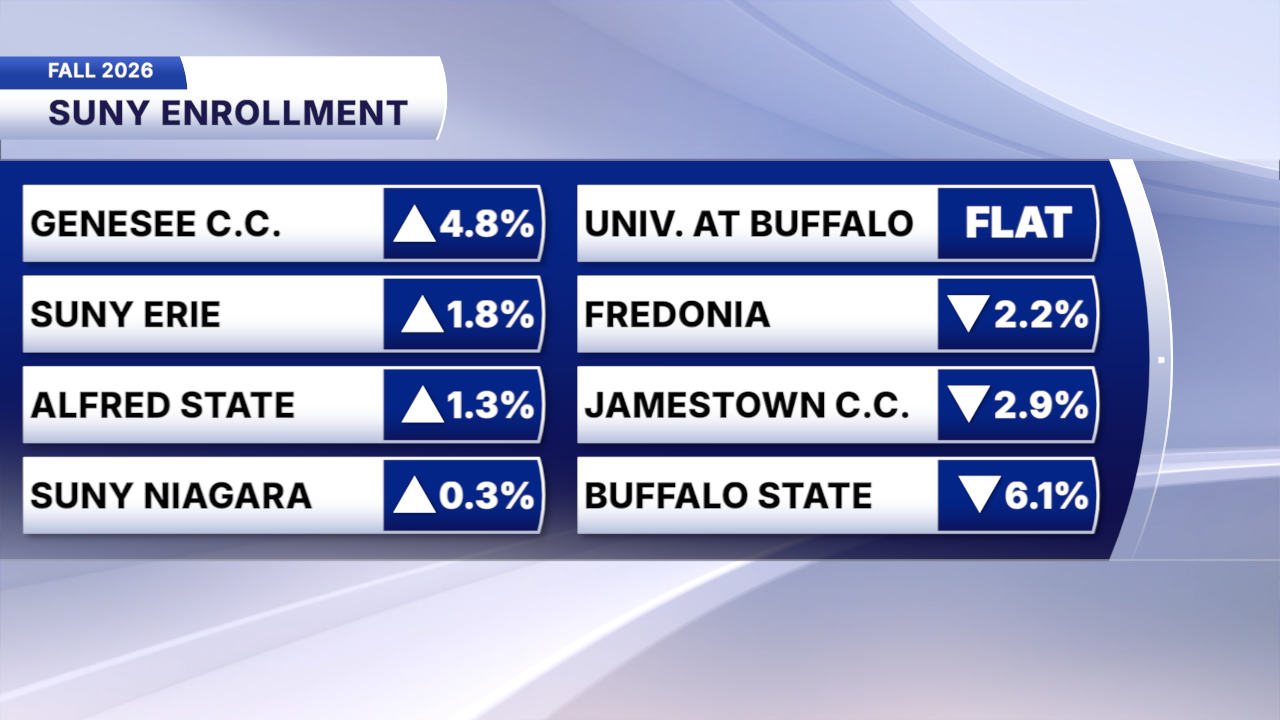
But Buffalo State University and SUNY Fredonia continue to experience enrollment declines.
"I continue to worry about Buffalo State and Fredonia," Dr. King told 7 News. "Buffalo State was down again fairly significantly."
King pointed to new leadership at Buffalo State, including President Jennifer Burris, and additional state investment in bilingual teacher education as potential opportunities for improvement.
"I'm still optimistic, but there's clearly work to do," he said.
Free community college program sees 50% growthOne of the biggest drivers of SUNY's enrollment growth is SUNY Reconnect, a program launched in 2025 that provides free community college tuition, fees, books and supplies for eligible adults between the ages of 25 and 55 pursuing degrees in high-demand fields.
Those fields include healthcare, advanced manufacturing, cybersecurity, information technology and others.
Enrollment in the program has increased from more than 5,600 students last year to approximately 8,400 this year, a jump of more than 50%.
King said the program will expand again in January 2027, allowing eligible adults who already have college degrees to return to school to pursue new career opportunities.
"There are four million New Yorkers in the workforce without college degrees," Dr. King said. "So there's a lot of adult learners who would benefit from these opportunities."
SUNY also reported a 5.5% increase in enrollment among students ages 25 and older.
International enrollment drops sharplyDespite the overall growth, SUNY is facing significant challenges involving international students.
Enrollment among international graduate students fell 22% over the past year, a decline the chancellor attributes to changes in federal immigration and visa policies.
"That is very tough for our university centers," Dr. King said. "So we're worried about that."
Dr. King criticized the Trump administration's approach to international students, arguing that visa restrictions and uncertainty about employment opportunities are discouraging talented students from coming to the United States.
"Turning these students away, which the Trump administration is doing by making it hard for folks to get visas, blocking students from certain countries from getting visas, and creating a lot of confusion about whether or not students will be able to do internships or get their first job in the U.S. What they're doing is actually undermining American economic competitiveness," Dr. King said.
He warned that universities in other countries, including China, Singapore, Germany and France, are benefiting as students consider alternatives to American institutions.
A shrinking pool of high school graduatesAnother major challenge facing SUNY is the projected decline in New York's traditional college-age population.
According to a 2024 study by the Western Interstate Commission for Higher Education, the number of high school graduates in New York is projected to decline by approximately 27% between 2023 and 2041.
That would mean roughly 54,500 fewer students graduating from high school annually by 2041.
Dr. King acknowledged the demographic challenge but said SUNY can continue growing by reaching students who have historically been less likely to attend college.
"The way we think about it is there's still plenty of students to go get. They just may not be the traditional students," King said.
That includes veterans, adult learners, low-income students and first-generation college students.
Dr. King said attracting those students will require colleges to change how they operate, including offering more evening and weekend classes, providing childcare and keeping financial aid offices open beyond traditional business hours.
"Our campuses are making those cultural shifts," King said.
Despite the challenges facing some individual campuses, the chancellor remains optimistic about SUNY's overall direction.
"As you look across the SUNY system, the trends are strong and the growth was really across every sector," Dr. King said. "So we're on the move."


